Most fast-growing businesses don’t fail because of ambition; they stall because their systems can’t keep up. As your business scales, processes become more sophisticated and the wrong systems can hamper your ability to scale. The configurable tools (HubSpot, Pipedrive, Monday.com etc.) that got you where you are may no longer suit what comes next.
So what does comes next? What should you think about before choosing your next system or platform?
Below are practical considerations to take on when looking to adopt new solutions in 2026; especially if you’re planning a CRM implementation or broader operational uplift.
Where Should Your Tech Stack Start?
Know Your Current Pain Points and Future Needs
Many of us have been there: the burden of inefficient tools and excess admin prevents us from focusing on system improvements and innovation. The idea of a shiny new tool that will solve your pain and elevate work to more enriching and business-critical tasks is alluring; but without proper consideration of the operational and structural constraints you currently face, you could invest in something that’s not fit for your next step.
Selecting the right solution requires a balance between:
- what is broken today, and
- what you’ll need in 2 to 4 years as you continue to scale.
The market for operational platforms offers a broad spectrum: from workflow automation and configurable CRMs through to enterprise solutions like Salesforce / ServiceNow, and on to fully custom development.
Take the time to find the right blend of configuration, customisation, integration, and cost for your business.
Before AI, Get Your Foundations Right
What an AI readiness assessment actually looks at
A common mistake at this point is to assume you need an enterprise data warehouse and a six-figure consulting engagement before you can do anything with AI. You do not. Most Australian SMEs have everything they need already on their existing stack: a CRM, an accounting platform, and free or near-free access to a cloud data warehouse such as BigQuery or Snowflake.
An AI readiness assessment looks at four things. First, your processes: which workflows are candidates for AI, and which are too unstable to automate yet. Second, your data: where it lives, how clean it is, and which systems can talk to each other. Third, your CRM and operational systems: whether they are fit for purpose as the live layer that AI will read from and write back to. Fourth, your team and change capacity: whether the operating model can absorb new systems without reverting to old habits.
This is the same assessment we run for clients through our AI Readiness Audit. It is documented, scoped to SME budgets, and based on the existing systems you already own rather than enterprise platforms you do not need.
How Do You Make Sure Your Data Is Actually Clean?
Strong Data Hygiene Matters
Strong foundations start with clean, accurate data, but “clean data” is rarely a one-off job. In most SMEs, data quality drifts because teams move fast, fields are optional, processes differ across people, and integrations create duplicates.
If you’re planning a CRM implementation, treat data hygiene as a core workstream, not a tidy-up task at the end. The goal isn’t perfection, the goal is consistency, so your CRM becomes a reliable system of record rather than a second “best guess” database.
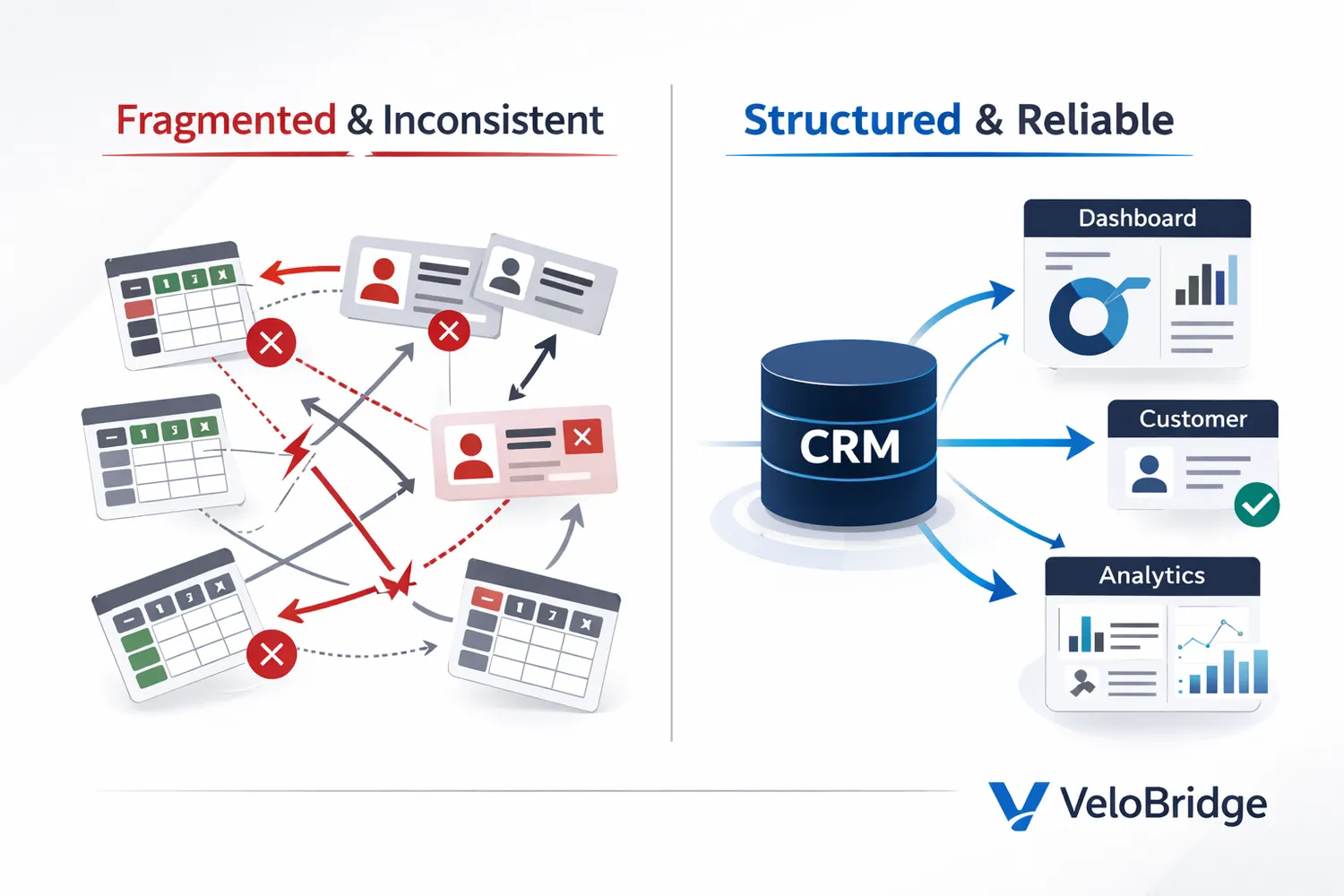
When your data is good, you can:
- report on what’s really happening
- see where money is coming from
- spot bottlenecks in your processes
- make decisions with confidence
To make it practical, here are three data moves that consistently pay off in CRM rollouts:
- Define what “good” looks like (in plain English). Example: “Every active customer must have an owner, a lifecycle stage, and a primary contact method.” You’re setting minimum standards so reporting and automation don’t break.
- Standardise a small set of data points that drive most outcomes. You don’t need 200 fields, pick the ones that power pipeline reporting, customer comms, and service delivery (e.g., lifecycle stage, product/service type, region, last contact date). An obvious move here is to drive users to dropdown, multiselect or other field types that standardise response, rather than offering the flexibility of free text.
- Create simple rules that prevent regression. Mandatory fields at key steps, dropdowns instead of free text where it matters, and dedupe rules/integration checks so you don’t reintroduce mess on day one.
When your data is clean and structured, you’re ready for AI, not before.
How Do You Avoid Over-Customisation?
Customisation Can Slow You Down
It might seem smart to tailor everything to how you work now. But over-customisation can slow you down, make systems harder to maintain, and bake in assumptions that change as you grow.
When designing a system or systematised process, I encourage clients to start simple and grow. If there are nuances that require manual intervention under specific circumstances, start with broad strokes and use real usage data to guide refinements.
This approach:
- makes solutions easier to build and maintain
- reduces rework caused by “assumed” workflows
- simplifies change management and training
Example: I recently worked with a client implementing automatic payment reminders. Due to legacy processes, they initially wanted different reminder schedules depending on service type. That would have increased complexity and added to the mental load of the customer service team. The business impact of harmonising the schedule was negligible, but the simplification reduced operational complexity and brought forward time to value.
How Important Is Change Management?
The Tech Is the Easy Part
Recently we have been fortunate to work with teams who were eager for new systems, so adoption felt relatively easy. Even then, change management can’t be underestimated. We saw that inconsistent training led some team members to work inefficiently, while others (keen to solve a customer problem) found workarounds to system limitations that caused knock on issues.
Most change management approaches share common principles for a reason; they work!
- align leadership on the change, strategic aims, and ambition
- communicate the vision early and regularly (without over promising)
- build willingness and excitement across the user base
- prepare users with training, workshops, town halls, and clear documentation
- make it stick, change management doesn’t end at go live; it requires ongoing reinforcement
- measure adoption so issues are caught early before they become expensive, entrenched problems
Plan for change. Budget for it. Manage it just like a project.
How Should You Choose a CRM as a Growing SME?
Here’s a definition that helps keep projects grounded:
A CRM implementation is successful when your CRM becomes the default place your team works, from lead to cash without workarounds.
Choosing a CRM is not about finding the platform with the most features. It is about finding a system that can be configured and shaped to reflect how your business actually operates, today and as it continues to evolve.
For growing SMEs, the ability to configure workflows, data models, permissions, and automation is not a “nice to have”. It is the mechanism that allows the CRM to support the business rather than forcing the business to bend around the tool. Well applied, configuration and selective customisation are what turn a generic CRM into a system that feels fit for purpose.
Fit to your operating mode
Whether you are sales-led, service-led, ecommerce-led, or a blend, the CRM should support your real-world processes rather than require constant manual workarounds.
Reporting and decision support
Pipeline accuracy, forecasting, retention, unit economics, and visibility across the customer lifecycle should be achievable through configuration, not spreadsheets.
Integration capability
Email, telephony, accounting, ecommerce, and support tools need to connect cleanly so the CRM becomes the hub rather than just another system to update.
Change tolerance and maturity
The best CRM is one that can be configured to meet the business where it is now, while still allowing you to extend and refine processes as the organisation matures.
If you can’t explain why you chose the system in one sentence, you’re at risk of choosing on vibes rather than outcomes.
Which Delivery Model Is Right for You?
Bring together the right team to maximise your chance of success
Many growing businesses don’t have the luxury of an in-house technology team, and even those that do often need external support during implementation, migration, or periods of high change.
Choosing a delivery model comes down to capacity, capability, and cost:
- On-shore experts can be effective but often come with a significant price tag and time and materials structures that don’t always reward efficiency.
- Off-shore partners can deliver excellent value, but need a structured operating model to manage timezone, language, and cultural differences.
- Long term, AI-assisted coding will reshape software development. For now, our team are using AI for proofs of concept, prototyping, and accelerating point solutions, with experienced engineers still required to architect, review, and harden security.
At VeloBridge, we use an intentionally hybrid approach: our Australian-based team partners closely with clients to understand the business, define requirements, and manage delivery, while our off-shore development team delivers high-quality solutions at the pace modern delivery demands. This model helps enterprise businesses move faster without compromising governance, security, or quality.
What Should You Do Now?
If you are thinking about the next step for your tech stack in 2026, the priorities have not changed: clarify your processes, clean your data, choose tools that support where you are going, and treat change management as a first-class workstream.
What has changed is the speed at which AI is moving from optional to expected. SMEs that get the foundations right in 2026 will be running AI workflows in production by 2027. SMEs that do not will be playing catch-up against competitors who did.
For a structured, fixed-fee starting point, our AI Readiness Audit covers the assessment of your current systems, the design of the foundations you will need, and the prioritised AI workflow roadmap that follows from it. It is a ten-day engagement and the price is published on the page.
Book a discovery call for an honest conversation about where you are and what comes next.