You launched your CRM six months ago, or you deployed your first AI workflow into production last quarter. Either way, something has shifted. The business has grown, the team has changed, the processes have evolved, and the systems that were configured to support the old version of your business are now quietly falling behind. This is one of the most common patterns we see in fast-growing SMEs. The implementation goes well, the team adopts it, and then nothing happens. Nobody owns the roadmap. Nobody is reviewing whether the system still reflects how the business actually operates.
Small frustrations build up, workarounds appear, and eventually someone says “we need a new CRM” when what they actually need is someone to look after the one they have.
What happens to your CRM after go-live?
Most production systems stop evolving the moment the implementation partner walks out the door. Whether the system is a CRM or an AI workflow, this is where the real problem usually begins.
The implementation phase gets all the attention. There is budget, there is a project plan, there are workshops and training sessions and a go-live date. Then the partner hands over the keys, the project closes, and the CRM becomes someone’s side responsibility alongside everything else they do.
For a while, that works fine. But businesses are not static. New products get launched, teams restructure, pricing changes, reporting requirements shift, regulations update. The CRM should be evolving alongside all of this, but without someone owning that evolution, it stagnates.
What tends to follow is a cycle most SMEs will recognise. Something breaks or a gap becomes obvious. You call the original implementation agency, or a new one. They spend time relearning your system and your business. They quote a piece of work at a rate that makes your eyes water. The work gets done, the agency leaves, and the cycle repeats six months later.
That model is expensive and it never builds momentum. Every engagement starts from scratch because there is no continuity, no retained context, and no one who truly understands how your business has changed since the last time someone looked at the CRM.
Why do most CRMs stop delivering value after the first year?
Because they are treated as infrastructure, not as a product.
Infrastructure gets maintained, but products get managed, and the difference matters.
When a CRM is treated as infrastructure, it gets patched when something breaks. When it is treated as a product, it gets a roadmap, a backlog, a prioritisation framework, and someone who is accountable for making sure it continues to serve the business as that business changes.
Most SMEs do not have a dedicated CRM product owner. They do not need one full time. But they do need someone who understands the system, understands the business, and can translate between the two consistently. Without that person, the CRM drifts. Features go unused because nobody trained new starters on them. Data quality degrades because validation rules were never updated to match new processes. Workarounds become entrenched because there is nobody to capture them as requirements and feed them back into the system.
The longer this goes on, the wider the gap between what the CRM does and what the business needs it to do. By the time someone decides to act, the remediation is a project in itself.
Why do AI workflows degrade faster than CRMs?
Because the models, prompts, and data all drift over time, and nobody notices until customers do.
A CRM that nobody owns will quietly stagnate over twelve to eighteen months. An AI workflow that nobody owns will degrade in weeks. A chatbot starts hallucinating once the product catalogue changes and nobody updates the prompt, and a document processing workflow that hit 96 per cent accuracy in pilot drifts down to 78 per cent after an upstream vendor pushes a model update. A quote generation agent ends up outputting outdated prices because the pricing rules were never wired into the source of truth.
AI managed services exist for the same reason CRM product management exists: live systems need someone watching them. The difference is cadence. AI workflows need monitoring weekly, not annually. The model below covers both: the same three-layer ownership structure, applied to the system that actually runs your business, whether that system is a CRM, an AI workflow, or both.
What does product management as a service actually look like in practice?
A dedicated team that treats your CRM like a product, because that is what it is.
We have been running this model with a client for over a year now. They are a national services business operating on SugarCRM, with a distributed team and operationally complex workflows. Their CRM is central to how they run the business, from scheduling through to invoicing. It needs to keep up.
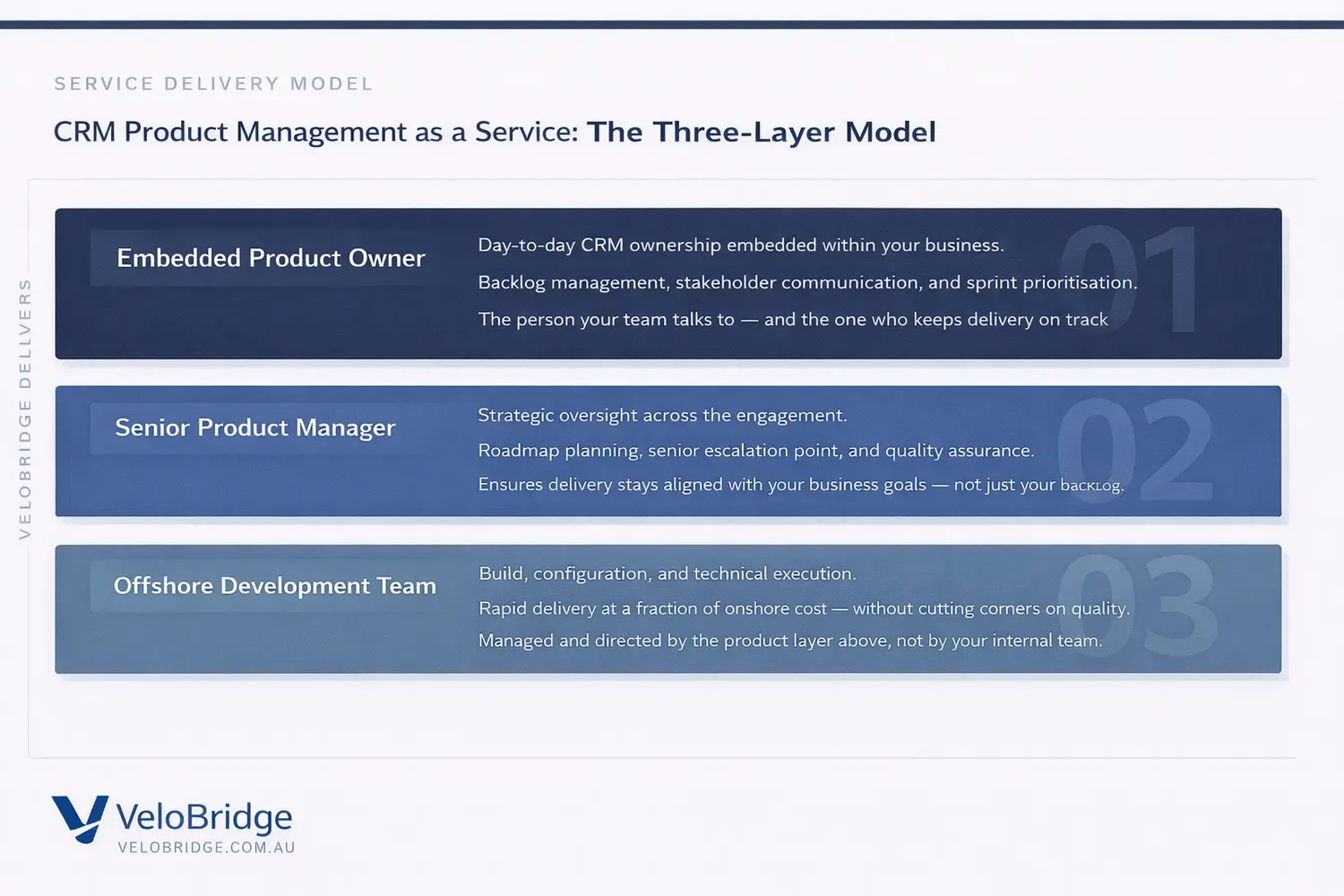
The model has three layers.
An embedded product owner, on the ground in the business. This person works alongside your team day to day. They understand the processes, the language, the frustrations, and the opportunities. They manage the backlog, triage support requests, and translate business needs into clear technical requirements. They run the CRM service desk, making sure day-to-day issues are captured and resolved without losing sight of the bigger picture.
A senior product manager who provides oversight, strategic direction, and mentorship. This is not a full-time role. You do not need a senior executive sitting in every standup. You need their expertise when it counts: shaping the roadmap, challenging priorities, managing relationships, and making sure the product owner is developing in the role. They bring the experience that turns a good backlog into a coherent product strategy.
An offshore development team for quality technical delivery at the pace the product roadmap demands. They build, configure, test, and deploy. They work from well-defined requirements and within a structured development process. The same team operates AI workflow tuning, prompt management, and observability instrumentation as part of AI managed services engagements, using a consistent toolchain across CRM and AI work. That capability sits alongside the product management model rather than replacing it.
Together, this functions as a full CRM support operation. Product prioritisation, monthly business reviews, a structured backlog with weighted scoring for larger initiatives, an agile development cycle, and a monthly release cadence complete with change management, release notes, and team communication.
What is included in AI managed services?
Continuous monitoring, prompt tuning, model evaluation, and the next round of workflow build.
AI managed services is the production-time equivalent of CRM product management. The deliverables are different but the operating shape is the same. Each month, we monitor workflow accuracy and cost, tune prompts as performance data accumulates, evaluate any vendor model updates before they reach production, and add new workflows from the roadmap as priorities shift. Each quarter, we run an executive review covering performance, cost, and the next phase of roadmap.
Pricing is structured the same way as the CRM model: a predictable monthly retainer that scales with the surface area you have in production, not a percentage of value created or a per-transaction charge. The retainer covers the tuning, monitoring, and incremental build that keeps AI workflows working as the business changes around them. This is how operational efficiency from AI is preserved over time rather than peaking in the first quarter after launch and quietly eroding.
How do you prioritise what to build and when?
With a framework, not a queue of whoever shouts loudest.
One of the first things we establish with any client on this model is a prioritisation framework. Without one, CRM work tends to be reactive. Whoever shouts the loudest gets their issue addressed first, regardless of whether it is the most valuable thing to work on.
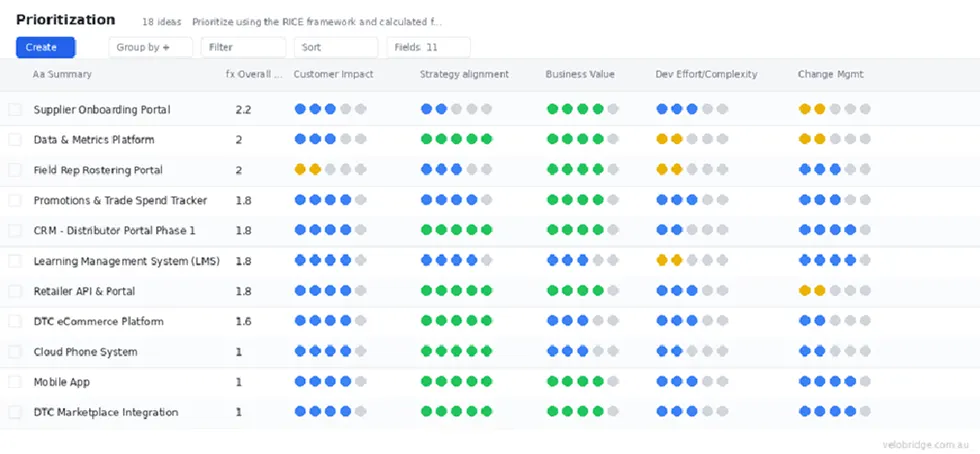
We use a weighted scoring model for larger initiatives. Each request is evaluated against customer impact, strategy alignment, business value, development effort and complexity, and the change management implications of delivery. That gives you a ranked backlog where the reasoning is transparent and defensible. It also means the product owner can have an honest conversation with stakeholders about why something is or is not being worked on this month.
Example: Weighted prioritisation board for a CRM product backlog
For day-to-day CRM support, the service desk handles triage. Bug fixes, minor configuration changes, user questions, access requests. These are tracked, resolved, and reported on so the business has visibility of where time is being spent.
The monthly release cadence is important. Rather than ad hoc changes pushed into production whenever they are ready, we batch work into monthly releases. Each release is tested, documented, and communicated to the team with clear release notes explaining what has changed and why. This is CRM support for SME businesses done properly, and it is what CRM support as a service should actually mean. It brings discipline to a process that most organisations leave entirely to chance.
Why is offshore development hard, and how do you make it work?
By being honest about the challenges and building a process that accounts for them.
I am not going to pretend that managing an offshore development team is straightforward. It is not. We met with half a dozen offshore development businesses before selecting our partner, and even with the right team, the model requires deliberate structure to work well.
The challenges are real. Timezone differences mean you cannot always get an instant answer. Communication styles differ, and what feels like a clear brief to you might be interpreted differently by someone in a different cultural context. Quality expectations need to be explicitly defined, not assumed. Requirements need to be tighter and more detailed than you would write for someone sitting next to you.
What makes it work is process: clear, documented requirements for every piece of work, defined acceptance criteria before development starts, a structured handover between the product owner and the development team, and code review and testing protocols that are followed consistently, not selectively. And a product owner who acts as the bridge, someone who understands the business context well enough to spot when something has been built correctly but for the wrong reason.
When this model is running well, you get high quality technical output delivered at pace, combined with the business context and continuity that a purely offshore arrangement could never provide.
What does this cost compared to the alternative?
Predictable, consistent, and almost certainly less than you think.
The traditional model for CRM evolution is to engage an agency when you have a problem. Most CRM implementation agencies bill on a time-and-materials basis. That means every engagement starts with a scoping phase you are paying for, delivered by someone who needs to relearn your business. The rate card is built for project work, not ongoing product management. You pay a premium for sporadic access to people who do not retain context between engagements.
Our model inverts that. You get a dedicated team with embedded knowledge of your business, your system, and your processes. The cost is predictable month to month, which means you can budget and forecast with confidence. This is product support for SME businesses that actually scales with you, rather than billing you for the privilege of explaining your own business to a new consultant every six months.
Over a twelve-month period, the total investment in this model is typically comparable to two or three traditional agency engagements, but with significantly more output and none of the ramp-up waste.
For PE or VC-backed portfolio companies, this model has an additional advantage. It can be standardised across acquisitions. The same product management framework, the same offshore development partner, applied consistently across the portfolio. That reduces operational risk and makes the technology transformation story far easier to articulate at exit.
Is product management as a service right for your business?
If your CRM is live or your AI workflows are in production, and your business is still moving, it probably is.
This model is not for businesses that are still selecting or implementing a CRM, or scoping their first AI workflow. We have separate services for that, including the AI Readiness Audit for first-time AI buyers. This is for businesses that already have systems in production and need a better answer than calling an agency every time something needs to change.
It works particularly well for SMEs in the $5 million to $30 million revenue range without an internal IT team or product function, but whose operations depend on systems that are business-critical to daily work. If your CRM is the place your team works every day, or your AI workflows are processing live customer interactions, the systems deserve to be managed like products. Reactive support has always been the default for SMEs. Product management as a service should run the other way: proactive and embedded, moving at the pace of your business.
If that sounds like your business, get in touch for a conversation about how the model would work for you. We will tell you straight if it is not the right fit.